Website under development: Some sections may be incomplete or temporarily unavailable. The current content should not yet be regarded as final.
Computational Chemist

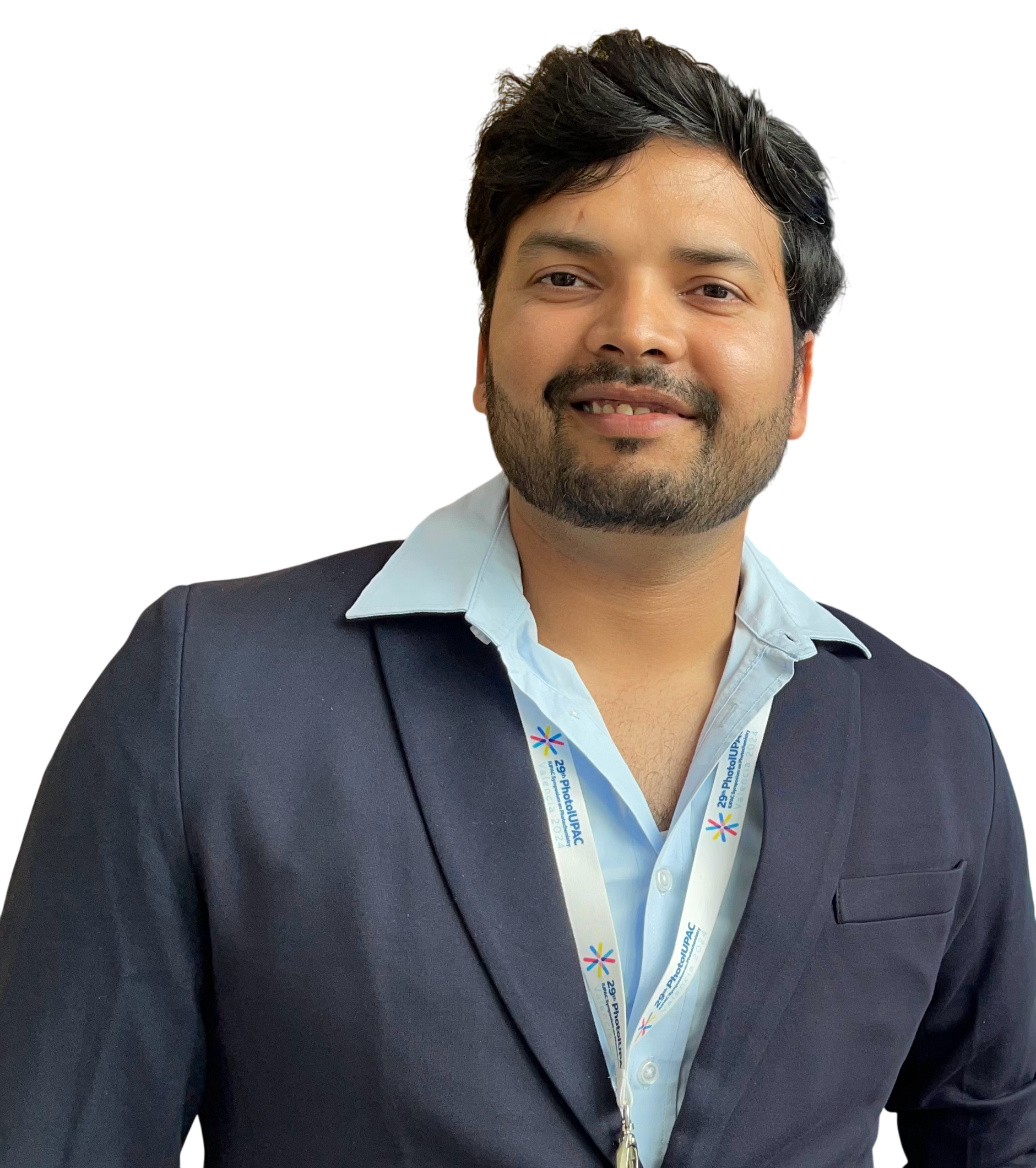
Prashant Kumar

Dr. Prashant Kumar
Research Associate in Computational Chemistry
University College London · London, United Kingdom

Computational chemist working at the intersection of electronic-structure theory, excited-state chemistry, molecular dynamics, machine learning, and data-driven molecular discovery, with research directed towards understanding and predicting the photophysical and photochemical processes that govern molecular materials. Particular interests lie in optoelectronics, photoactivatable CO-releasing molecules (PhotoCORMs), photocatalysis, open-shell systems, transition-metal complexes, and carbon capture and storage.

Dr. Prashant Kumar

Research Interests

My research combines quantum chemistry, excited-state dynamics, machine learning, and automated computational workflows to understand and design photoactive molecular materials for optoelectronics, healthcare, catalysis, sensing, and sustainable energy applications.

01

Molecular Materials for Next-Generation Optoelectronics

Computational investigation and design of phosphorescent, TADF, and radical-based molecular emitters, with emphasis on emission, excited-state dynamics, degradation, and operational stability.

See more →
02

Photoactive Molecular Systems and Antimicrobial Resistance

Understanding photoactive molecules that release therapeutic species or generate reactive oxygen species, with applications in photodynamic treatment and antimicrobial resistance.

See more →
03

Data-Driven Design of Photocatalysts for CO2 Conversion

Combining electronic-structure theory, machine learning, and high-throughput screening to discover molecular photocatalysts for carbon-dioxide activation and conversion.

See more →
04

Excited-State Molecular Sensors: ESIPT and Aromaticity

Investigating how excited-state proton transfer, aromaticity, electronic redistribution, and molecular environment control fluorescence and sensing behaviour.

See more →

Research Experience

2024 – Present
Research Associate
University College London · London, United Kingdom
Research on radical-based OLED systems, electronic-structure theory, doublet emission, machine-learning-assisted nonadiabatic dynamics, and automated high-throughput computational workflows.
2023 – 2024
Postdoctoral Researcher
LCPQ-CNRS · Toulouse, France
Computational investigation of photochemical mechanisms in transition-metal complexes, including Re(I) and Mn(I) systems, using excited-state electronic-structure methods and machine-learning-assisted high-throughput screening.
2019 – 2023
PhD in Computational Chemistry
KU Leuven · Leuven, Belgium
PhD research on excited-state processes in molecular materials for organic light-emitting diodes.
2016 – 2018
MSc in Chemistry
Indian Institute of Technology Bhubaneswar · India
Research on nonadiabatic dynamics using semiclassical methods and concepts from dynamical systems and chaos theory.

Selected Publications

Selected work spanning excited-state chemistry, molecular photophysics, organometallic systems, OLED materials, and computational methodology.

2025
Impact of isomerism on the photoproduction of carbon monoxide and singlet oxygen by visible-light absorbing rhenium(I) photoCORMs
Valentine Guilbaud, Prashant Kumar, Martial Boggio-Pasqua, Evelyne Delfourne, Sonia Ladeira, Eric Benoist, Isabelle Dixon, Suzanne Fery-Forgues
Spectrochimica Acta Part A: Molecular and Biomolecular Spectroscopy
DOI →
2023
Phosphorescent Properties of Heteroleptic Ir(III) Complexes: Uncovering Their Emissive Species
Prashant Kumar, Daniel Escudero
The Journal of Physical Chemistry A
DOI →
2021
Computational Protocol to Calculate the Phosphorescence Energy of Pt(II) Complexes: Is the Lowest Triplet Excited State Always Involved in Emission? A Comprehensive Benchmark Study
Prashant Kumar, Daniel Escudero
Inorganic Chemistry
DOI →
2021
Twisted BODIPY derivative: intersystem crossing, electron spin polarization and application as a novel photodynamic therapy reagent
Yu Dong, Prashant Kumar, Partha Maity, Ivan Kurganskii, Shujing Li, Ayhan Elmali, Jianzhang Zhao, et al.
Physical Chemistry Chemical Physics
DOI →

Complete publication record available on Google Scholar .
Methods & Technologies

Programming

Python · Fortran · R · Bash · Linux/Unix

Electronic Structure

DFT · TDDFT · Coupled Cluster · CASSCF · CASPT2 · NEVPT2

Quantum Chemistry Software

Gaussian · ORCA · Q-Chem · GAMESS · Dalton · Turbomole

Molecular Dynamics

SHARC · Newton-X · Quantum ESPRESSO

Machine Learning

PyTorch · scikit-learn · NumPy · Pandas · MLatom

Scientific Computing

HPC workflows · automation · high-throughput calculations · scientific data analysis

Selected Awards & Research Support

UKRI HPC Allocation — Awarded 8,576,000 CPU hours on Cirrus for data-driven modelling of organic radicals.
MISTI Global Seed Fund — Research support for the project Designing Stable OLEDs with Machine Learning and Simulations .
Royal Society of Chemistry Travel Grant — Award supporting presentation of postdoctoral research on Re(I) complexes.
COST Action DAEMON Travel Award — Support for presenting research on OLED degradation.

Academic Profiles

For publications, research updates, professional information, and computational projects, you can find me through the academic and professional profiles below.

Get in Touch

Interested in my research, potential collaborations, or computational chemistry? Feel free to send me a message.

Global Visitors

An approximate geographical overview of visitors to this website.